Think of your car’s filters like a pair of high-quality masks. One protects the “heart” of your vehicle—the internal combustion engine—while the other protects you and your passengers inside the cabin. When these critical barrier elements get clogged, your car starts to get stuffy, sluggish, and potentially very expensive to repair.
1. The Engine Air Filter: Your Vehicle’s “Lungs”
Located under the hood inside a sealed plastic airbox, the engine air filter serves as the primary defense system for your engine’s internal combustion process. To burn gasoline or diesel efficiently, an engine requires a massive volume of air—roughly 10,000 gallons of air for every single gallon of fuel burned!
The Vital Job
The engine filter traps environmental contaminants—such as road dust, dirt, leaves, sand, insects, and fine particulate matter—before they can enter the intake manifold and cylinder chambers. Without this filter, microscopic abrasive particles would scour precision-machined cylinder walls, pistons, and valves, leading to rapid mechanical wear and premature engine failure.
What Happens When It’s Ignored?
When an engine air filter reaches its dust-holding capacity, the pleats become choked with grime, drastically restricting airflow:
- Sluggish Acceleration & Throttle Lag: Deprived of clean oxygen, the engine struggles to achieve the optimal air-fuel combustion ratio, resulting in noticeable power loss when passing or merging.
- Decreased Fuel Economy: Modern Engine Control Units (ECUs) attempt to adjust fuel mixture ratios to compensate for restricted airflow, often burning extra fuel unnecessarily.
- Engine Misfires & Black Exhaust Smoke: Severely restricted airflow causes incomplete combustion, which fouls spark plugs and sends raw, unburnt fuel into the exhaust system.
- Illuminated “Check Engine” Light: Mass Air Flow (MAF) sensor fault codes (such as P0101) will trigger when expected air volume deviates from real-time readings.
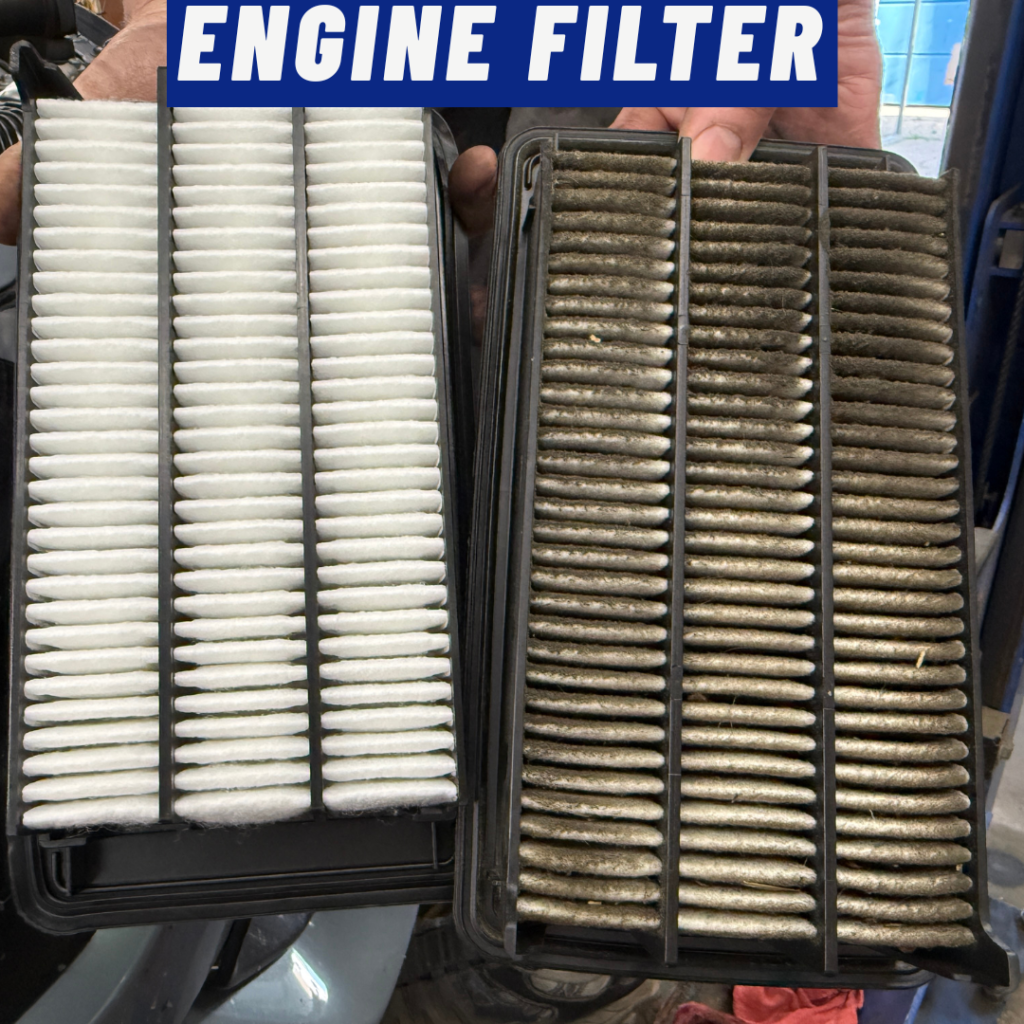
Bright white pleated media with maximum airflow and zero restriction
VS.
Heavy dirt coating, trapped insects and 30,000+ miles of road grime.
2. The Cabin Air Filter: Your HVAC Respiratory Shield
While the engine air filter protects the machine under the hood, the cabin air filter is dedicated entirely to driver and passenger health. Tucked behind the glovebox or near the windshield cowl, this filter scrubs all ambient air pulled into your heating, ventilation, and air conditioning (HVAC) system.
The Vital Job
As you drive through city traffic, highway corridors, or dusty rural roads, your vehicle passes through dense plumes of airborne contaminants. The cabin air filter traps:
- Fine pollen, ragweed, and environmental allergens
- Mold spores and fungal spores
- Industrial soot, silica dust, and brake dust
- Microscopic particulate matter ($PM_{2.5}$) down to sub-micron sizes
What Happens When It’s Ignored?
- Musty “Old Gym Bag” Odors: Trapped moisture and organic debris inside dark filter pleats create the ideal breeding ground for mold, mildew, and bacteria—filling your car with persistent bad smells every time the fan turns on.
- Weakened A/C & Heating Airflow: Clogged filter media creates high static pressure resistance. Your blower motor works double-time, but only a weak trickle of air emerges from the vents.
- Dangerous Window Fogging: Restricted HVAC airflow prevents the defroster from clearing cabin moisture quickly in humid, cold, or rainy weather, dangerously impairing driver visibility.
- Premature Blower Motor Burnout: Restricting airflow starves the fan motor of cooling, leading to electrical overheating and blown fuses or motor failure.
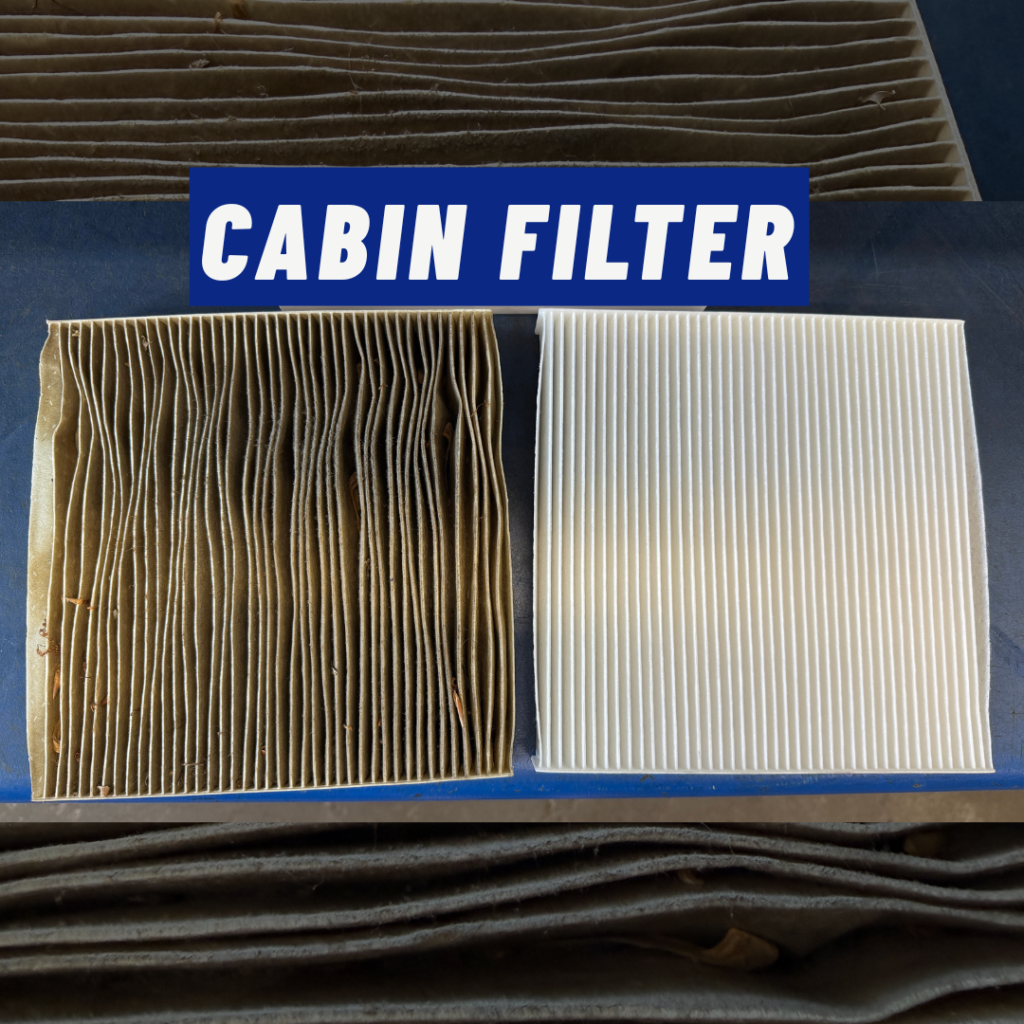
Dark soot layer, embedded leaves, pollen matting and moisture accumulation
VS
Clean synthetic layers for peak air purification & pollen defense.
3. Bonus Nightmare Fuel: The Rodent Nest & Blower Motor Destruction
⚠️ Critter Contamination Warning
Leaving a vehicle parked outdoors, near wooded areas, or unused for extended periods invites unwanted roommates. The enclosed cabin filter housing is warm, dry, and sheltered—making it prime real estate for mice, squirrels, and chipmunks.
Critters routinely chew through intake screens and shred the soft accordion paper of the cabin filter to build cozy nests. However, the destruction doesn’t stop at the filter itself:
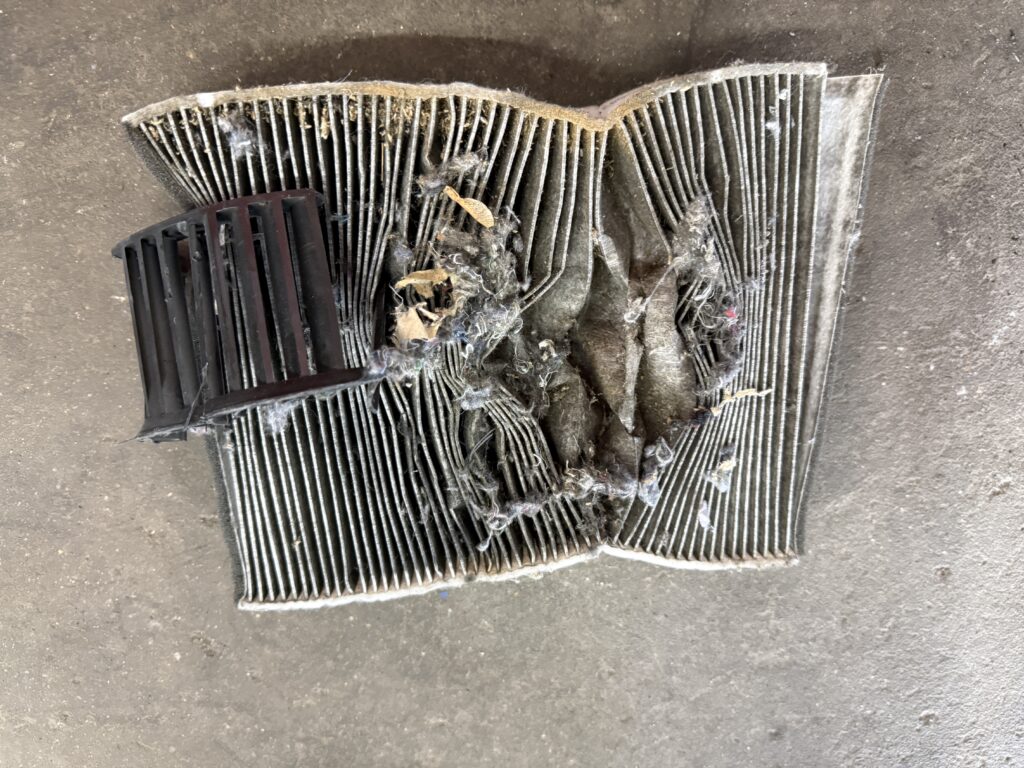
The Chain Reaction of Damage:
- Chewed Filter Media: Mice shred the filter, destroying its ability to trap dust or allergens.
- Debris Falling into the Blower Motor: Shredded insulation, acorn hulls, and nesting materials fall directly into the fast-spinning fan cage below.
- Out-of-Balance Fan & Broken Cage: The heavy, off-center nest causes violent vibration when the fan is turned on, snapping delicate plastic fan fins.
- Expensive Mechanical Repairs: What should have been a simple $20–$30 preventive filter swap turns into a $500 to $1,000+ emergency repair requiring dashboard teardown, HVAC duct sanitization, and fan replacement.
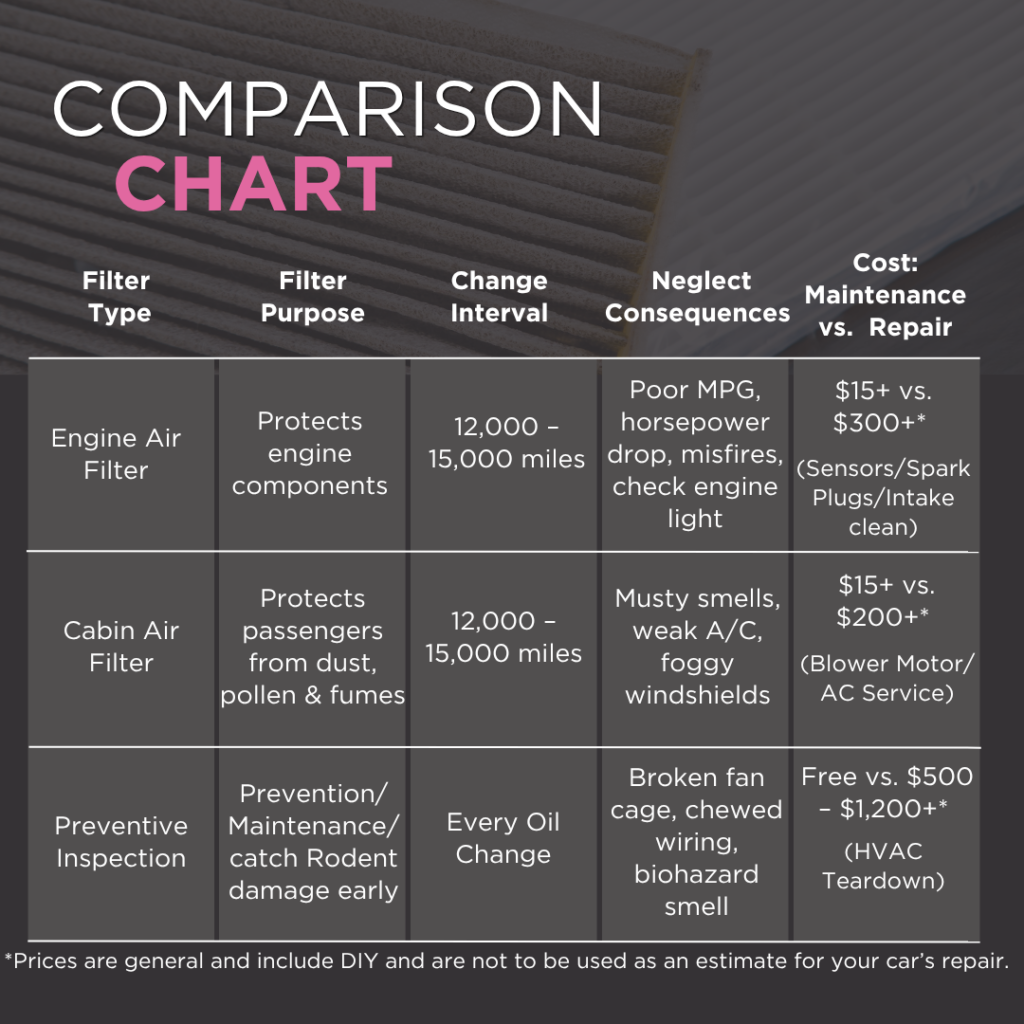
4. Filter Comparison & Cost Breakdown
5. Maintenance Schedule & Professional Best Practices
The Pro Standard: Check at Every Oil Change
As a general rule of thumb, professional auto technicians check both air filters during every routine oil change service. This simple 2-minute visual check catches contamination early before fuel economy drops or rodents make themselves at home.
Conditions That Require More Frequent Replacement:
- Driving on Gravel or Unpaved Roads: Heavy airborne dust clouds saturate filter media up to 3x faster than normal highway driving.
- High Pollen Seasons & Wildfire Smoke: Organic particulates and sticky sap residues quickly clog microscopic filter pores.
- Urban Stop-and-Go Smog: High concentrations of industrial soot and diesel exhaust darken filter media prematurely.
- Frequent Outdoor Parking: Exposure to falling leaves, pine needles, and rodent activity near engine bays.
Air Filters: Small Part, Huge Impact
Air filters are among the simplest and most cost-effective maintenance items on your vehicle, but neglecting them can trigger a domino effect of poor performance, foul odors, and expensive repairs.
Whether you’re noticing weak airflow from your dashboard vents, a dip in fuel mileage, or that dreaded musty smell every time you turn on the heater, don’t wait for a warning light. Have both filters inspected during your next routine service—your engine, your lungs, and your wallet will thank you.
Sandston Automotive
SMALL TOWN FEEL, BIG TIME SERVICE
804-737-7206